

Notes on Annual Savings by Stakeholder Group
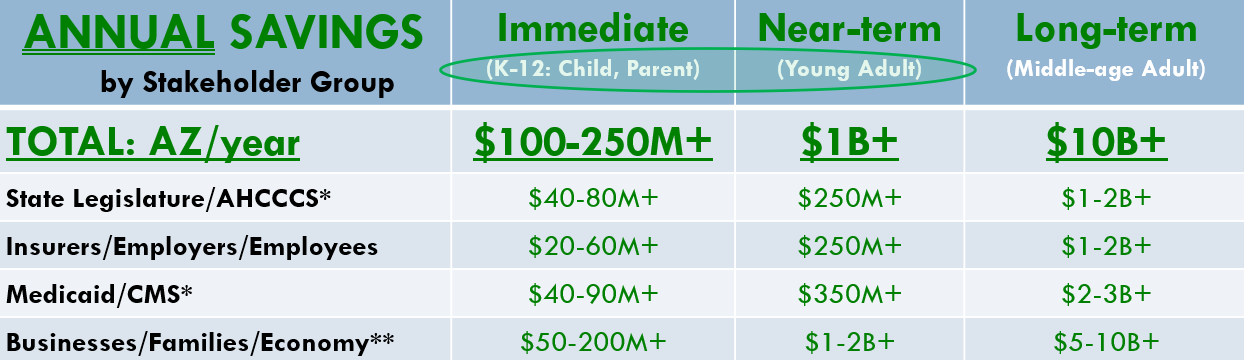
Preliminary draft estimates. Mutual matching investments result in mutual savings.
Abbreviations
CMS = Centers for Medicare & Medicaid Services (regulates Medicaid at the federal level—together with AHCCCS in Arizona and other state Medicaid agencies in other states; CMS operates within the US Department of Health & Human Services).
Formulas
Immediate Savings column: lower-range (left-side-of-dash) estimate based on child/student direct medical costs, & upper-range/right estimate based on parent medical costs; except that Businesses/Families/Economy row based on indirect, chronic-related work/business productivity costs. Children & their parents already have high chronic condition prevalence, so there is major rapid savings potential.
K-12/Young-Adult/Middle-age Adult (Nonelderly Adult), respectively:
Current Chronic Prevalence 12%/25%/50%;
Extra Annual Costs Above-Normal-without-Chronic-Conditions due to Chronic Disease: $1K/$5K/$7K respectively;
Reduction in Preventable Chronic Disease: -50%/-33%/-20%; (estimated by HFUS; based on research and government data showing prevalence levels and potential impact on health by increasing physical activity and healthier nutrition for 13 years K-12. Impact would decrease over time, as initial healthier habits fade out; however, by postponing the future on-set and severity of chronic conditions, future health costs will be substantially lower, than if most of those adults had been inactive and had less healthy nutrition throughout childhood.)
Example of how health care savings add up, by postponing diabetes or heart disease etc. onset in adulthood for 1 child:
- if delay onset by 5 years: save $25,000; if delay by 10 years: save $50,000;
- if delay until elderly/ Medicare: save up to $250,000
- multiply this by 100,000+ students for potential savings.
Notes: Calculated based on typical adult cardiovascular and diabetes costs. Preliminary draft estimates. Mutual matching investments by funders result in mutual savings.
Immediate savings:
Immediate savings column: lower-range (left-side-of-dash) estimate based on child/student direct medical costs, & upper-range/right estimate based on parent medical costs; except that Businesses/Families/Economy row based on indirect chronic/productivity costs. Other ROI analysis: see other slides. Children & their parents already have high chronic condition prevalence, so there is major rapid savings potential.
Upper-end Immediate Savings from school-based strategies are from both K-12 students’ (per UArizona/SUSD outcomes—see Reeves, 2016 & other slides) & parents’ healthier behavior & related cost savings (with parent savings est. 15% of Young Adult savings: Immediate Young Adult savings based on est. of ~50% of Young Adults being parents (Pew Research, 2018), & that parents will be substantially more likely than non-parents to change their behavior & improve their health immediately, as a result of K-12 programs with their children—an estimated 1/3 parents improve health).
Total AZ chronic costs in 2016 were at least $24B, of which ~1/2 from inactivity & unhealthy nutrition (obesity/“metabolic syndrome”) (Milken Institute, 2018).
Approx. 20% of that could be prevented via K-12 settings, including by postponing the onset & reducing the severity of chronic conditions and costs.
Stakeholder investments:
Build up from $50M to $500M+/year investment for full savings, with each stakeholder group contributing ~$15M+/group/year—growing based on results to $150M+/yr (more from CMS eventually since CMS receives even more savings federally).
Matching ratios between stakeholder-funder/investor groups TBD—rough rule of thumb could be:
-
1/3 state/AHCCCS,
-
1/3+ CMS/federal,
-
1/3 private health insurer/major self-insured employer/employee.
Co-/Matching investing also sustains campaign, by spreading the costs, while strengthening the incentive for each group to continue investing due to co-matching multiplier effect.
There is some overlap/double-counting in savings here, with savings allocation between categories (esp. State/AHCCCS & Medicaid/CMS) and between insurers/employers/employees TBD/negotiated.
Additional Table Notations
*Assumes Medicaid/CMS allows state waiver to keep/re-invest child/K-12 savings, in return for state appropriations and achieving health outcomes & savings. CMS eventually invests more because it saves more, e.g., from ACA Medicaid expansion & marketplace subsidies.
(This could change if there are radical reductions in Medicaid and the ACA, in which case private health plans may need to contribute more. After all, private plans will have to pick up the cost of uninsured patients (previously covered primarily by public funds through Medicaid/AHCCCS and “Obamacare”), which those patients cannot pay. Those unreimbursed costs get shifted by health care providers to private payers, when public payers are not available.)
**Estimated per Milken Institute studies that Businesses/Families/Economy (B/F/E) will save 10-20+% in greater productivity: less absenteeism, presenteeism; higher wages, sales, profits; higher GDP, tax revenues. Businesses/Family/Economy Immediate Savings roughly estimated based on reduced parent absenteeism & presenteeism due to less child chronic & other health issues + improvement in parent health (see slides and other webpages).
+: Plus sign reflects major additional future savings, when factoring in future population and prevalence growth including in young adulthood. Key underlying estimates/projections, based on current preventable chronic rates/costs/evidence-based program-effectiveness.
Requires permanent annual K-12 co-investments by state, federal and private health and other sectors, with regular outcomes metrics & evaluations to maintain trust/support and to sustain savings.
Key underlying estimates/projections, based on current preventable chronic rates/costs/evidence-based program-effectiveness.
A simple way to look at this is as follows:
- 13 years of healthier habits including major increases in physical activity postpone the onset of chronic disease by up to 13 years, due to funded minimum minute mandates at the nationally recommended activity minute levels needed to preserve health.
- [Even a more conservative average postponement of chronic disease of 8-10 years, beyond when the individual would normally have begun having conditions, adds up to about 20% of the nonelderly pre-Medicare adult lifespan of 47 years (from 19 to 65 years of age)].
- Since many individuals will continue with much healthier habits, even if the majority “fall off the bandwagon” to some extent during adulthood, prolonged healthier habits among many will further increase the savings from both postponed onset and reduced severity for a significant percentage of adults.
- So both AHCCCS/Medicaid and private health insurance subscribers AND companies can save at least 20% of what they would have paid otherwise in health care costs over those nonelderly adult years.
- The economic productivity savings in GDP, including higher wages and disposable income, are similar to the health cost savings.
Another way to look at the health care cost savings:
As noted earlier, the savings add up, by for example postponing diabetes or heart disease etc. onset in adulthood for 1 child:
- if delay onset by 5 years: save $25,000;
- if delay by 10 years: save $50,000;
- if delay until elderly/ Medicare: save up to $250,000
Multiply the above by 100,000+ students, for potential cumulative savings of $2.5B-$25B, from just one cohort of Arizona students.
We also need to bear in mind that:
Even in the privately-insured population there are high levels of inactivity & unhealthy nutrition etc. and significant risks of chronic disease. This can be seen in the 1 in 4 white and middle-income adolescent prediabetes prevalence rates.
It is much easier to keep kids active & give them healthy nutrition in a controlled “captive audience” school environment for 13 years, than to change adult behavior.
Even if this only postpones the onset of chronic conditions for 5-10 years, enormous savings result & the investment is fully paid back.
In addition, healthy habits developed K-12 lay ground-work for follow-through policies in adulthood, providing a viable opportunity to extend habits and savings much later in life.
For example, if only patients followed through on their doctors’ recommendations, which most commonly include “exercise more and eat better”, adults would be much healthier. After 13 years of quality physical and health education, doctors will find it a lot easier for patients to do what they ask.
We achieve this by sustainably funding adequate amounts of quality, effective, accountable, evidence-based physical, nutrition, mental wellness and other health ed and school-based prevention K-12.
(See latest notes in most recent HFUS slides and related webpages on this site.)
Notes @03/22/2025